













The short answer: To stay regular while traveling, keep your fiber intake steady, drink more water than usual, move your body each day and try to keep your normal bathroom routine. Pre-portioned fiber packets make the fiber part easier because you don't have to measure anything or rely on airport and hotel food.
Key takeaways
- Travel is a well-known trigger for constipation. The National Institute of Diabetes and Digestive and Kidney Diseases (NIDDK) lists travel among the routine changes that can affect bowel movements (NIDDK).
- Adults need roughly 22 to 34 grams of fiber a day, depending on age and sex (NIDDK). Most travel meals fall short.
- If you add fiber, add fluids too. Fiber works better with plenty of liquid (NIDDK).
- Start any new fiber before your trip, not on the plane. Adding too much fiber too quickly can cause gas and bloating (Mayo Clinic).
Why travel throws off your digestion
Your gut runs on routine. When you travel, several things change at once:
- Meal timing shifts. Early flights, time zones and skipped meals move your normal eating windows.
- Food changes. Airport, hotel and restaurant meals are often lower in fiber and higher in refined carbs than what you eat at home.
- You drink less water. Flights are dry, and people often drink less to avoid bathroom trips.
- You sit more. Long flights and drives mean less movement, and movement helps keep digestion going.
- You hold it. Unfamiliar bathrooms and packed schedules make people ignore the urge to go. NIDDK lists ignoring the urge as a cause of constipation in its own right (NIDDK).
It's common. In a University of Utah study of 68 travelers who answered questions about their bowel habits, mostly people returning from missionary service abroad, 9% developed constipation and 45% developed bloating during their trip (Digestive Diseases and Sciences).
A simple travel plan
Before you leave (3 to 7 days out)
- If you plan to use a fiber supplement on the trip and don't already take one, start now at a low amount. Let your body adjust at home rather than on day one of vacation.
- Notice when you usually go. Most people have a natural window, often after breakfast or coffee. Try to protect that window while you're away.
On travel days
- Bring an empty water bottle through security and refill it after. Aim to drink steadily through the day.
- Pack fiber you don't have to think about: single-serve fiber packets, fruit, nuts or whole-grain snacks.
- Get up and walk during layovers. On long drives, stop every couple of hours.
At your destination
- Eat at least one high-fiber meal a day: beans, lentils, vegetables, berries, oats or whole grains.
- Keep your fiber supplement at the same time each day. If you take it in your morning coffee at home, do the same in the hotel.
- Don't ignore the urge to go. Building in a few unhurried minutes after breakfast helps.
When you get home
- Go back to your normal routine and meals right away. Digestive changes that start during a trip can sometimes stick around after it (Digestive Diseases and Sciences), so it helps to reset quickly.
What to look for in travel fiber packets
| What to check | Why it matters |
|---|---|
| Fiber per packet | Know how much you're getting. 5g is a common single-serving amount |
| Type of fiber | Different fibers act differently. See our guide to FOS, inulin, psyllium and PHGG |
| Taste and texture | Unflavored, fully dissolving fiber goes into coffee, water or juice, which matters when you can't choose your drinks |
| Sugar | Many flavored fiber drinks add sugar. Look for zero sugar if that matters to you |
| Packaging | Single-serve packets are easier to carry and TSA-friendly compared with a tub and scoop |
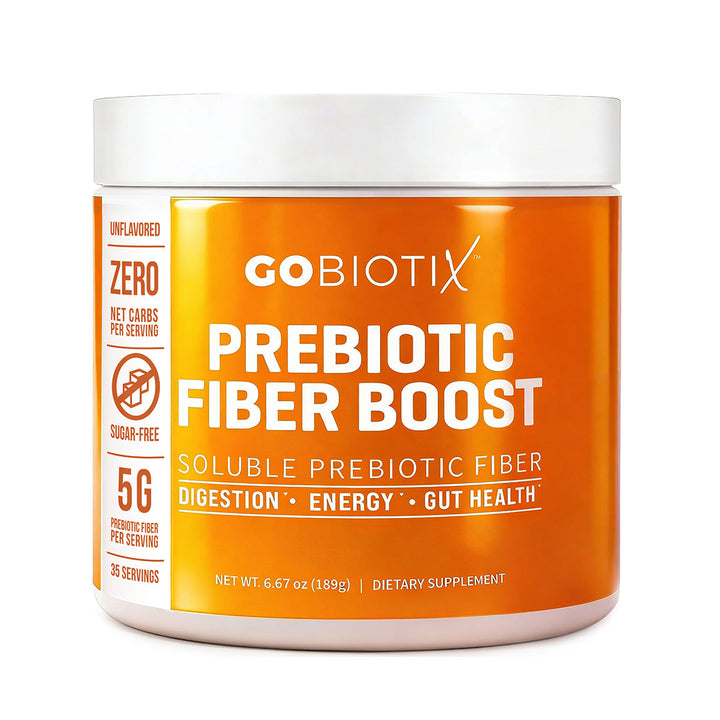
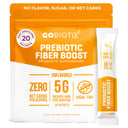
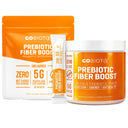
GoBiotix Prebiotic Fiber Travel Pack puts 5g of FOSSENCE® P95 prebiotic fiber (short-chain FOS) in each single-serve packet. It's unflavored, sugar-free and dissolves in any drink, so you can tear a packet into your coffee or water bottle without measuring. It's the same fiber as our full-size Prebiotic Fiber Boost tub. Shop the Travel Pack.
When to talk to a doctor
See a health care professional if constipation lasts more than a few weeks or comes with severe pain, blood in your stool, unexplained weight loss, or a sudden change in your usual habits. If you're traveling abroad and have diarrhea with fever, get medical advice before using any fiber or other remedy.
FAQ
Can I bring fiber packets on a plane? Yes. Powdered supplements in sealed single-serve packets are generally easy to carry in a carry-on. TSA may ask you to separate larger amounts of powder for screening, so small packets are simpler than a tub.
Should I take fiber on the day I fly? If you already take fiber regularly, keep your usual routine. If you're new to fiber, start a few days before you travel so your body has time to adjust.
Can I put fiber in coffee? Unflavored soluble fibers like FOS dissolve in hot or cold drinks. Prebiotic Fiber Boost is designed to mix into coffee without changing its taste.
How much water should I drink with fiber? There's no single number for everyone. NIDDK recommends drinking plenty of water and other liquids whenever you increase fiber, and asking a health care professional how much is right for you (NIDDK).
Is a fiber supplement the same as a laxative? No. Fiber supplements add fiber to your diet. Stimulant laxatives work differently and are meant for short-term use. Talk to a pharmacist or doctor before using laxatives while traveling.
Sources
- NIDDK: Symptoms and causes of constipation
- NIDDK: Treatment for constipation
- NIDDK: Constipation, all content
- Mayo Clinic: Chart of high-fiber foods
- Digestive Diseases and Sciences: GI symptoms during and after travel outside the USA
These statements have not been evaluated by the Food and Drug Administration. This product is not intended to diagnose, treat, cure or prevent any disease.