









The short answer: FOS and inulin are prebiotic fibers. They're fermented by gut bacteria and selectively feed beneficial microbes. Psyllium is mainly a gel-forming bulk fiber that resists fermentation. PHGG (partially hydrolyzed guar gum) is a gentle, slowly fermented fiber that's certified low-FODMAP. The best choice depends on your goal: feeding gut bacteria, adding bulk for regularity, or keeping gas to a minimum with a sensitive stomach.
Key takeaways
- "Prebiotic" has a scientific definition: "a substrate that is selectively utilized by host microorganisms conferring a health benefit" (ISAPP). Not every fiber qualifies.
- Inulin produced more hydrogen and total gas than psyllium or wheat dextrin in a lab fermentation model (PubMed).
- Psyllium is highly resistant to fermentation and forms a gel (Critical Reviews in Food Science and Nutrition).
- Short-chain FOS increased beneficial bifidobacteria in a dose-dependent way, with 5g a day as the threshold where the effect showed up (PMC review).
- FOS and inulin are fructans, which are FODMAPs. People following a low-FODMAP diet may do better with PHGG (PMC, Monash FODMAP).
The four fibers at a glance
| FOS (fructooligosaccharides) | Inulin | Psyllium husk | PHGG (partially hydrolyzed guar gum) | |
|---|---|---|---|---|
| What it is | Short chains of fructose | Longer chains of fructose | Seed husk of Plantago ovata | Guar bean fiber broken into shorter pieces |
| Main job | Prebiotic: feeds beneficial bacteria | Prebiotic: feeds beneficial bacteria | Bulk and gel: adds stool bulk, helps regularity | Gentle prebiotic and regularity support |
| Fermented by gut bacteria? | Yes, quickly | Yes | Mostly resists fermentation | Yes, slowly |
| Gas potential | Moderate. Usually well tolerated at modest doses | Higher in lab tests | Low | Low |
| Low-FODMAP? | No (fructan) | No (fructan) | Not a fructan. Check serving size | Yes, Monash-certified products exist |
| Texture in drinks | Dissolves completely, no taste | Dissolves, slightly sweet | Thickens and gels | Dissolves, no taste |
| Common brands | Fossence®, NutraFlora® | Many "prebiotic" powders | Metamucil | Sunfiber® |
FOS
FOS are short chains of fructose that your small intestine can't digest. They reach the colon intact, where bacteria such as bifidobacteria ferment them.
- What the research shows: In studies of healthy volunteers, short-chain FOS increased fecal bifidobacteria in a dose-dependent way. Effects appeared from about 5g a day, and around 10g a day was described as the optimal tolerated dose (PMC review of Bouhnik et al.).
- Tolerance: Researchers have reported short-chain FOS as well tolerated at 2.5 to 10g a day in healthy people. A 6-week trial in people with minor functional bowel complaints used 5g a day because sensitive people can react more strongly to higher doses (British Journal of Nutrition).
- Best for: People who want a prebiotic that disappears into coffee or water and is easy to take daily.
- Watch out for: FOS is a fructan. If you know fructans bother you or you're on a low-FODMAP diet, start small or choose PHGG.
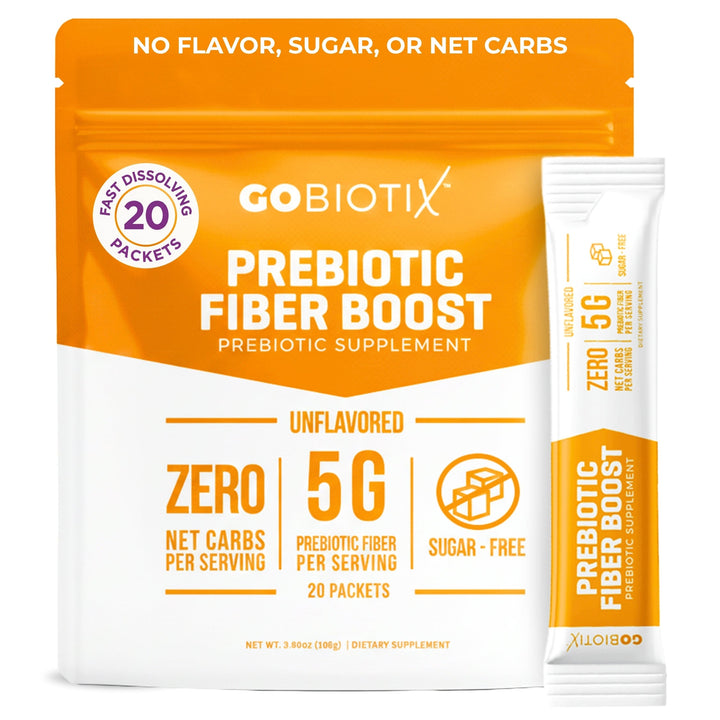
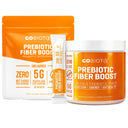
GoBiotix Prebiotic Fiber Boost uses FOSSENCE® P95, a short-chain FOS made from fermented cane sugar. Each scoop provides 5g. It's unflavored and sugar-free, and it dissolves fully in hot or cold drinks. See Prebiotic Fiber Boost.
Inulin
Inulin is the longer-chain cousin of FOS. It's often extracted from chicory root, agave or Jerusalem artichoke.
- What the research shows: Inulin is a well-studied prebiotic. In a lab model comparing three common fiber supplements, it produced significantly more hydrogen and total gas than psyllium or wheat dextrin (PubMed).
- Best for: People who tolerate fermentable fiber well and want a common, low-cost prebiotic.
- Watch out for: Gas and bloating, especially at higher doses or if you're new to fiber.
Psyllium husk
Psyllium is the fiber in products like Metamucil. It absorbs water and forms a gel.
- What the research shows: Psyllium's complex structure makes it more resistant to microbial breakdown than many other fibers (Critical Reviews in Food Science and Nutrition). In an MRI study of people with IBS, taking psyllium with inulin reduced the colonic gas that inulin alone produced (PMC).
- Best for: Adding stool bulk and supporting regularity.
- Watch out for: It thickens drinks, so drink it quickly and with plenty of water. It's not considered a classic prebiotic because it isn't selectively fermented.
PHGG
PHGG is made by breaking guar gum into shorter pieces, so it dissolves without thickening.
- What the research shows: PHGG ferments slowly and is one of the gentler fibers. Sunfiber® PHGG was the first fiber to be certified low-FODMAP by Monash University (Taiyo, Monash FODMAP).
- Best for: Sensitive stomachs and people following a low-FODMAP plan.
- Watch out for: Compare price per serving. PHGG products are often priced higher than basic psyllium.
How to choose
| If your main goal is… | Consider |
|---|---|
| Feeding beneficial gut bacteria with a fiber you won't taste | FOS |
| A low-cost prebiotic and you tolerate fiber well | Inulin |
| Adding bulk for regularity | Psyllium |
| Minimal gas, or you follow a low-FODMAP diet | PHGG |
| Fiber in your coffee | FOS or PHGG (both dissolve without thickening) |
| Fiber while traveling | Any fiber in single-serve packets. See our travel guide |
Tips for any fiber supplement:
- Start with a small amount and increase over 1 to 2 weeks. Adding fiber too quickly can cause gas and bloating (Mayo Clinic).
- Drink plenty of fluids (NIDDK).
- Use supplements to fill a gap, not to replace fiber-rich foods.
- If you take medication, ask your pharmacist about timing. Fiber can affect how some medicines are absorbed.
FAQ
Is FOS better than inulin? Neither is better for everyone. Both are prebiotic fructans. FOS has shorter chains, dissolves cleanly and was well tolerated at moderate doses in studies. Inulin produced more gas in lab tests. Your tolerance is the deciding factor.
Is psyllium a prebiotic? Not in the classic sense. Psyllium mainly works as a bulk-forming, gel-forming fiber and resists fermentation by gut bacteria.
Which fiber is least likely to cause bloating? Psyllium and PHGG tend to produce less gas than inulin. Starting with a low dose of any fiber and increasing slowly also helps.
Can I take a prebiotic and a probiotic together? Yes. A prebiotic feeds bacteria; a probiotic supplies live bacteria. Many people take both. See when to take probiotics.
What is FOSSENCE® P95? FOSSENCE® P95 is a branded short-chain FOS ingredient made from fermented cane sugar. It's the fiber in GoBiotix Prebiotic Fiber Boost.
Sources
- ISAPP: Prebiotic definition
- PubMed: Wheat dextrin, psyllium and inulin produce distinct fermentation patterns
- PMC: Psyllium reduces inulin-induced colonic gas production in IBS
- Critical Reviews in Food Science and Nutrition: Fermentation-resistant and non-fermentable fibers
- PMC: Dietary fiber intake and gut microbiota in human health
- British Journal of Nutrition: Short-chain FOS and digestive comfort
- PMC: FODMAP categories
- Monash FODMAP: Low-FODMAP PHGG fiber
- Taiyo: Sunfiber PHGG
These statements have not been evaluated by the Food and Drug Administration. This product is not intended to diagnose, treat, cure or prevent any disease.